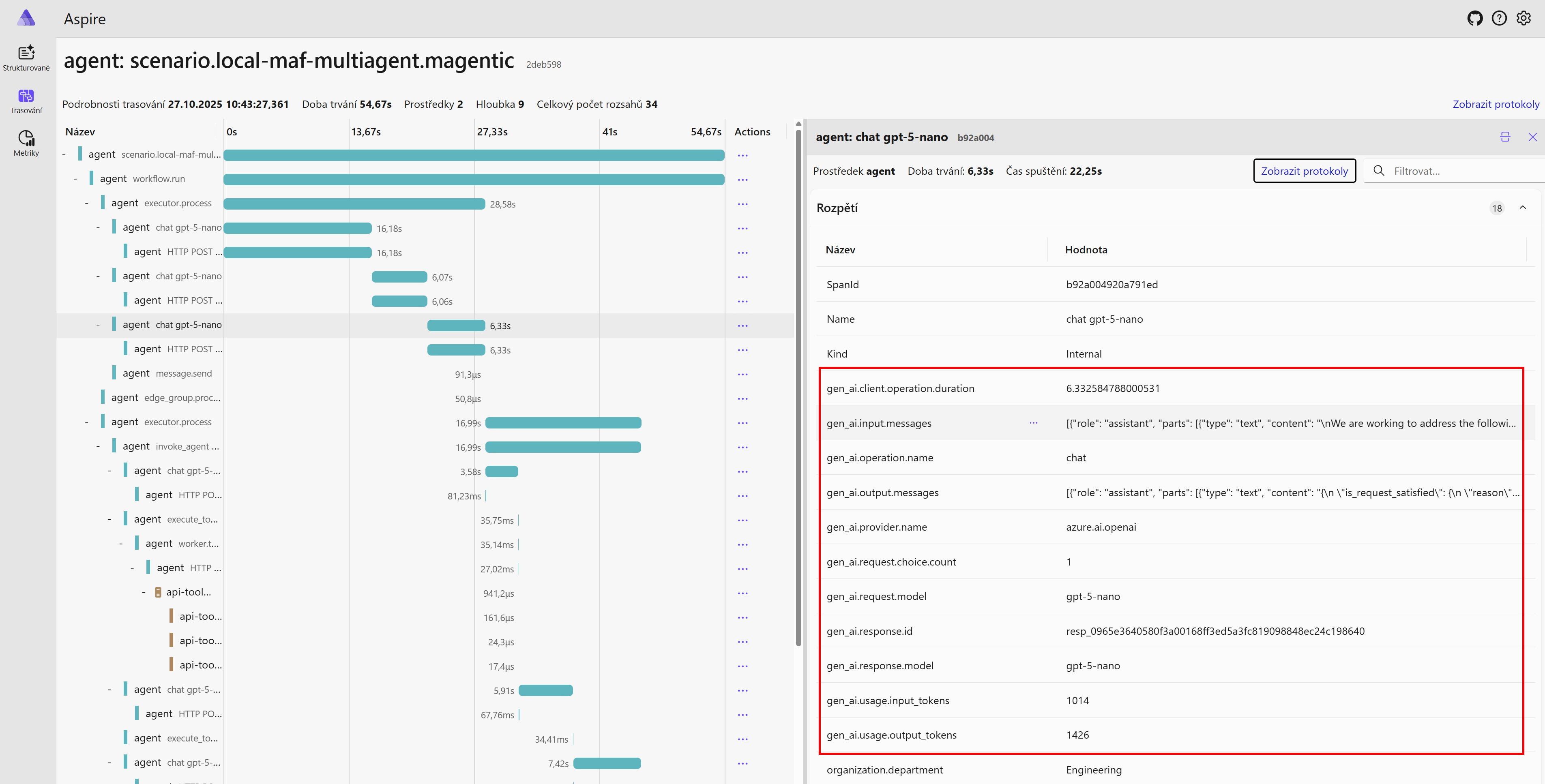
Výborné je, že tohle všechno lze v AKS držet v ConfigMap a Kubernetes manifestech. Aplikace pak stále posílá na jeden OTLP endpoint a kolektor rozhoduje, co kam odejde.
Helm šablona OTEL kolektoru v AKS
apiVersion: v1
kind: ConfigMap
metadata:
  name: {{ include "maf-demo.fullname" . }}-otel-collector-config
  labels:
    {{- include "maf-demo.labels" . | nindent 4 }}
    app.kubernetes.io/component: otel-collector
data:
  config.yaml: |
    receivers:
      otlp:
        protocols:
          grpc:
            endpoint: 0.0.0.0:4317
          http:
            endpoint: 0.0.0.0:4318

    processors:
      batch:
        timeout: 5s
        send_batch_size: 1024
      memory_limiter:
        check_interval: 1s
        limit_mib: 512

      # Transform processor for anonymization - strips PII and sensitive data
      transform/anonymize:
        error_mode: ignore
        trace_statements:
          - context: span
            statements:
              # Pseudonymize user.id using SHA256 for consistent hashing
              - set(attributes["user.id"], SHA256(attributes["user.id"])) where attributes["user.id"] != nil
              # Remove VIP status - boolean flag considered PII
              - delete_key(attributes, "user.is_vip")
              - delete_key(attributes, "user.roles")
              # Pseudonymize department for correlation while protecting identity
              - set(attributes["organization.department"], SHA256(attributes["organization.department"])) where attributes["organization.department"] != nil
              # Pseudonymize session and thread IDs
              - set(attributes["session.id"], SHA256(attributes["session.id"])) where attributes["session.id"] != nil
              - set(attributes["thread.id"], SHA256(attributes["thread.id"])) where attributes["thread.id"] != nil
              # Strip tool arguments and results - may contain sensitive data
              - delete_key(attributes, "tool.arguments")
              - delete_key(attributes, "tool.result")
              # Strip GenAI input/output messages - contains user queries and LLM responses
              - delete_key(attributes, "gen_ai.input.messages")
              - delete_key(attributes, "gen_ai.output.messages")
              - delete_key(attributes, "gen_ai.prompt")
              - delete_key(attributes, "gen_ai.completion")
              - delete_key(attributes, "gen_ai.request.model")
              - delete_key(attributes, "gen_ai.response.model")
              # Strip any other GenAI content using pattern matching
              - delete_matching_keys(attributes, "gen_ai\\..*\\.content")
              - delete_matching_keys(attributes, "gen_ai\\..*messages.*")
              # Redact common PII patterns in remaining string attributes
              - replace_all_patterns(attributes, "value", "\\b[A-Za-z0-9._%+-]+@[A-Za-z0-9.-]+\\.[A-Z|a-z]{2,}\\b", "EMAIL_REDACTED")
              - replace_all_patterns(attributes, "value", "\\b\\d{3}[-.]?\\d{3}[-.]?\\d{4}\\b", "PHONE_REDACTED")
              - replace_all_patterns(attributes, "value", "\\b\\d{4}[\\s-]?\\d{4}[\\s-]?\\d{4}[\\s-]?\\d{4}\\b", "CARD_REDACTED")
          - context: resource
            statements:
              # Pseudonymize user.id in resource attributes
              - set(attributes["user.id"], SHA256(attributes["user.id"])) where attributes["user.id"] != nil
              # Remove VIP status from resource
              - delete_key(attributes, "user.is_vip")
              - delete_key(attributes, "user.roles")
              # Pseudonymize department in resource
              - set(attributes["organization.department"], SHA256(attributes["organization.department"])) where attributes["organization.department"] != nil
              # Pseudonymize session in resource
              - set(attributes["session.id"], SHA256(attributes["session.id"])) where attributes["session.id"] != nil

        log_statements:
          - context: log
            statements:
              # Pseudonymize user identifiers in logs
              - set(attributes["user.id"], SHA256(attributes["user.id"])) where attributes["user.id"] != nil
              # Remove sensitive log attributes
              - delete_key(attributes, "user_message")
              - delete_key(attributes, "response")
              - delete_key(attributes, "tool_name")
              - delete_key(attributes, "arguments")
              - delete_key(attributes, "result")
              - delete_key(attributes, "user.is_vip")
              - delete_key(attributes, "user.roles")
              # Pseudonymize department and session
              - set(attributes["organization.department"], SHA256(attributes["organization.department"])) where attributes["organization.department"] != nil
              - set(attributes["session.id"], SHA256(attributes["session.id"])) where attributes["session.id"] != nil
              # Redact PII patterns in log body if it's a string
              - replace_all_patterns(attributes, "value", "\\b[A-Za-z0-9._%+-]+@[A-Za-z0-9.-]+\\.[A-Z|a-z]{2,}\\b", "EMAIL_REDACTED") where IsString(body)
              - replace_all_patterns(attributes, "value", "\\b\\d{3}[-.]?\\d{3}[-.]?\\d{4}\\b", "PHONE_REDACTED") where IsString(body)
          - context: resource
            statements:
              # Pseudonymize user.id in resource attributes for logs
              - set(attributes["user.id"], SHA256(attributes["user.id"])) where attributes["user.id"] != nil
              # Pseudonymize department in resource for logs
              - set(attributes["organization.department"], SHA256(attributes["organization.department"])) where attributes["organization.department"] != nil

        metric_statements:
          - context: datapoint
            statements:
              # Pseudonymize user identifiers in metrics
              - set(attributes["user.id"], SHA256(attributes["user.id"])) where attributes["user.id"] != nil
              # Remove VIP status from metrics
              - delete_key(attributes, "user.is_vip")
              # Pseudonymize department in metrics
              - set(attributes["organization.department"], SHA256(attributes["organization.department"])) where attributes["organization.department"] != nil
          - context: resource
            statements:
              # Pseudonymize user.id in resource attributes for metrics
              - set(attributes["user.id"], SHA256(attributes["user.id"])) where attributes["user.id"] != nil
              # Remove VIP status from resource for metrics
              - delete_key(attributes, "user.is_vip")
              # Pseudonymize department in resource for metrics
              - set(attributes["organization.department"], SHA256(attributes["organization.department"])) where attributes["organization.department"] != nil

    exporters:
      # Console exporter for troubleshooting
      debug:
        verbosity: detailed
        sampling_initial: 5
        sampling_thereafter: 200

      # OTLP exporter for Aspire Dashboard
      otlp:
        endpoint: {{ include "maf-demo.fullname" . }}-aspire-dashboard:18889
        tls:
          insecure: true

      # OTLP exporter for Anonymized Aspire Dashboard
      otlp/anonymized:
        endpoint: {{ include "maf-demo.fullname" . }}-aspire-dashboard-anon:18889
        tls:
          insecure: true

      # Azure Monitor exporter for Application Insights
      # Supports traces and logs (metrics not supported by App Insights OTLP ingestion)
      azuremonitor:
        connection_string: {{ .Values.appInsights.connectionString | quote }}

      # Langfuse OTLP exporter for LLM observability
      # Exports traces to Langfuse via HTTP/protobuf protocol
      otlphttp/langfuse:
        endpoint: {{ .Values.langfuse.endpoint | default "http://langfuse-web.langfuse.svc.cluster.local:3000/api/public/otel" | quote }}
        headers:
          Authorization: {{ .Values.langfuse.authorization | default "Basic " | quote }}

      # Prometheus Remote Write exporter for Azure Monitor Prometheus
      # Uses sidecar container for Azure AD token management
      # The sidecar listens on localhost:8081 and injects the Authorization header
      prometheusremotewrite:
        endpoint: "http://localhost:8081/api/v1/write"
        tls:
          insecure: true
        resource_to_telemetry_conversion:
          enabled: true

    service:
      pipelines:
        traces:
          receivers: [otlp]
          processors: [memory_limiter, batch]
          exporters: [otlp, azuremonitor, otlphttp/langfuse]

        # Anonymized trace pipeline - strips PII before sending to anonymized dashboard
        traces/anonymized:
          receivers: [otlp]
          processors: [memory_limiter, transform/anonymize, batch]
          exporters: [otlp/anonymized]

        metrics:
          receivers: [otlp]
          processors: [memory_limiter, batch]
          exporters: [otlp, prometheusremotewrite]

        # Anonymized metrics pipeline
        metrics/anonymized:
          receivers: [otlp]
          processors: [memory_limiter, transform/anonymize, batch]
          exporters: [otlp/anonymized]

        logs:
          receivers: [otlp]
          processors: [memory_limiter, batch]
          exporters: [otlp, azuremonitor]

        # Anonymized logs pipeline
        logs/anonymized:
          receivers: [otlp]
          processors: [memory_limiter, transform/anonymize, batch]
          exporters: [otlp/anonymized]
---
apiVersion: v1
kind: ServiceAccount
metadata:
  name: {{ include "maf-demo.fullname" . }}-otel-collector
  labels:
    {{- include "maf-demo.labels" . | nindent 4 }}
    app.kubernetes.io/component: otel-collector
    azure.workload.identity/use: "true"
  annotations:
    azure.workload.identity/client-id: {{ .Values.agent.clientId }}
    azure.workload.identity/tenant-id: {{ .Values.agent.tenantId }}
---
apiVersion: apps/v1
kind: Deployment
metadata:
  name: {{ include "maf-demo.fullname" . }}-otel-collector
  labels:
    {{- include "maf-demo.labels" . | nindent 4 }}
    app.kubernetes.io/component: otel-collector
spec:
  replicas: 1
  selector:
    matchLabels:
      {{- include "maf-demo.otelCollectorSelectorLabels" . | nindent 6 }}
  template:
    metadata:
      labels:
        {{- include "maf-demo.otelCollectorSelectorLabels" . | nindent 8 }}
        azure.workload.identity/use: "true"
    spec:
      serviceAccountName: {{ include "maf-demo.fullname" . }}-otel-collector
      containers:
      - name: otel-collector
        image: otel/opentelemetry-collector-contrib:{{ .Values.otelCollector.tag }}
        ports:
        - containerPort: 4317  # OTLP gRPC
          name: otlp-grpc
          protocol: TCP
        - containerPort: 4318  # OTLP HTTP
          name: otlp-http
          protocol: TCP
        - containerPort: 8888  # Metrics
          name: metrics
          protocol: TCP
        - containerPort: 8889  # Prometheus metrics
          name: prometheus
          protocol: TCP
        volumeMounts:
        - name: config
          mountPath: /etc/otelcol-contrib
          readOnly: true
        resources:
          {{- toYaml .Values.otelCollector.resources | nindent 10 }}
      # Sidecar container for Azure Monitor Prometheus remote write authentication
      # This container obtains Azure AD tokens using workload identity and proxies
      # Prometheus remote write requests with the Authorization header injected
      - name: prom-remotewrite
        image: mcr.microsoft.com/azuremonitor/containerinsights/ciprod/prometheus-remote-write/images:prom-remotewrite-20250814.1
        imagePullPolicy: Always
        ports:
        - name: rw-port
          containerPort: 8081
          protocol: TCP
        env:
        - name: INGESTION_URL
          value: {{ .Values.prometheus.remoteWriteEndpoint | quote }}
        - name: LISTENING_PORT
          value: "8081"
        - name: IDENTITY_TYPE
          value: "workloadIdentity"
        - name: CLUSTER
          value: {{ .Values.clusterName | default "aks-cluster" | quote }}
        livenessProbe:
          httpGet:
            path: /health
            port: rw-port
          initialDelaySeconds: 10
          timeoutSeconds: 10
        readinessProbe:
          httpGet:
            path: /ready
            port: rw-port
          initialDelaySeconds: 10
          timeoutSeconds: 10
        resources:
          requests:
            cpu: 50m
            memory: 64Mi
          limits:
            cpu: 200m
            memory: 128Mi
      volumes:
      - name: config
        configMap:
          name: {{ include "maf-demo.fullname" . }}-otel-collector-config
---
apiVersion: v1
kind: Service
metadata:
  name: {{ include "maf-demo.fullname" . }}-otel-collector
  labels:
    {{- include "maf-demo.labels" . | nindent 4 }}
    app.kubernetes.io/component: otel-collector
spec:
  type: ClusterIP
  ports:
    - port: 4317
      targetPort: otlp-grpc
      protocol: TCP
      name: otlp-grpc
    - port: 4318
      targetPort: otlp-http
      protocol: TCP
      name: otlp-http
    - port: 8888
      targetPort: metrics
      protocol: TCP
      name: metrics
  selector:
    {{- include "maf-demo.otelCollectorSelectorLabels" . | nindent 4 }}